n8n vs Zapier for Ecommerce: Which Automation Tool Fits Your DTC Brand?
A DTC skincare brand cut automation costs from $740 to $61/month by switching to n8n. Learn how to choose between n8n vs Zapier for ecommerce based on order volume and workflow complexity.

A DTC skincare brand running 22,000 monthly orders cut its automation bill from $740/month to $61/month by switching from Zapier to a self-hosted n8n instance on a $40 VPS. Most scaling ecommerce brands do the exact opposite — they stay on per-task billing long after it stops making financial sense.
The n8n vs Zapier for ecommerce decision is not about which tool has more integrations. It is about matching an automation platform's billing model, workflow architecture, and failure-handling capabilities to your specific order volume and operational complexity. Here is how to make that call with actual numbers.
Key Takeaways
- Zapier's per-task billing becomes expensive fast: a 5-step order workflow consumes 5 tasks per order, not 1
- n8n's self-hosted plan has no per-task fees, making it significantly cheaper at volumes above 10,000 orders/month
- Zapier wins on setup speed and beginner accessibility; n8n wins on cost control and complex conditional logic
- For multi-channel inventory sync across Shopify, WooCommerce, and Amazon simultaneously, n8n is the stronger technical choice
- Payment webhook failure handling differs materially between the two platforms, a critical consideration for high-revenue stores
Quick Comparison: n8n vs Zapier for Ecommerce at a Glance
| Feature | n8n | Zapier |
|---|---|---|
| Pricing model | Flat monthly or self-hosted (pay for server only) | Per-task billing (scales steeply) |
| Shopify integration | Native node (orders, customers, products, webhooks) | Native + 500+ pre-built templates |
| WooCommerce integration | Native node | Native with broad template library |
| Amazon integration | Via HTTP node (custom setup required) | Native integration available |
| Self-hosting option | Yes, full Docker/VPS deployment | No, cloud-only |
| Webhook reliability | Strong, with built-in retry and error routing | Basic failure notifications; manual re-runs needed |
| Multi-step workflow complexity | Advanced conditional branching, loops, sub-workflows | Limited branching on lower tiers |
| Technical skill required | Developer familiarity with JSON and node config | Minimal — no-code UI accessible to non-developers |
| Best for | High-volume DTC brands, technical teams | Early-stage or low-volume stores needing fast setup |
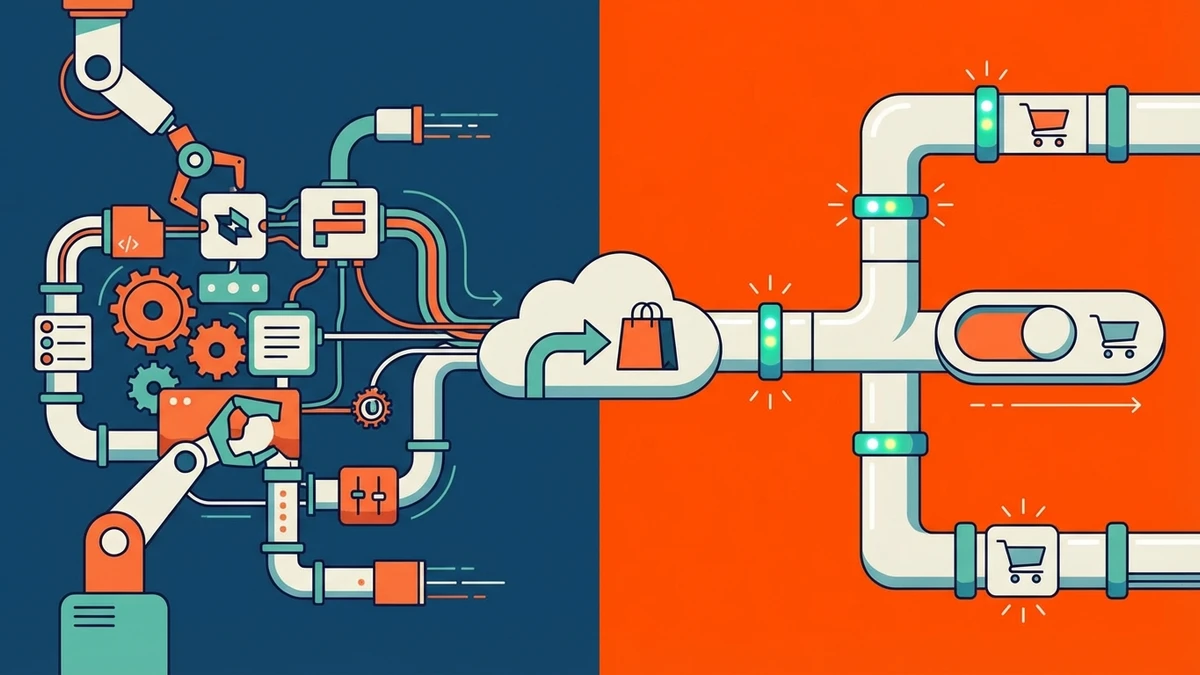
The Real Cost Difference for High-Volume DTC Brands
Zapier's pricing structure has a mechanic that most operators miss: it charges per task, not per workflow run. A single order fulfillment automation that triggers an order confirmation, updates inventory, segments the customer in Klaviyo, routes the shipment in ShipStation, and sends a post-purchase SMS consumes 5 tasks per order, not 1.
Here is what that looks like at scale:
| Monthly Orders | Tasks Generated (5-step workflow) | Zapier Est. Monthly Cost | n8n Self-Hosted Cost |
|---|---|---|---|
| 5,000 | 25,000 | ~$100–$150 | $20–$40 (VPS) |
| 20,000 | 100,000 | ~$500–$800 | $40–$60 (VPS) |
| 50,000 | 250,000 | $1,200+ (custom plan) | $60–$100 (larger VPS) |
At 100,000 tasks/month, Zapier's Professional plan exceeds $500/month. A self-hosted n8n instance on a $40/month VPS handles the same volume with no per-task fees. Annualized, that gap is $5,500 to $8,000 per year for a brand processing 20,000 orders/month, a number that shows up directly in contribution margin.
Pro Tip: Before migrating to n8n, audit your Zapier task logs for the past 90 days. Many brands discover that 20 to 30% of their task consumption comes from failed retries and test runs that were never cleaned up, inflating their actual automation cost significantly.
Ecommerce Workflows Where Each Platform Wins and Where They Fail
Multi-channel inventory sync
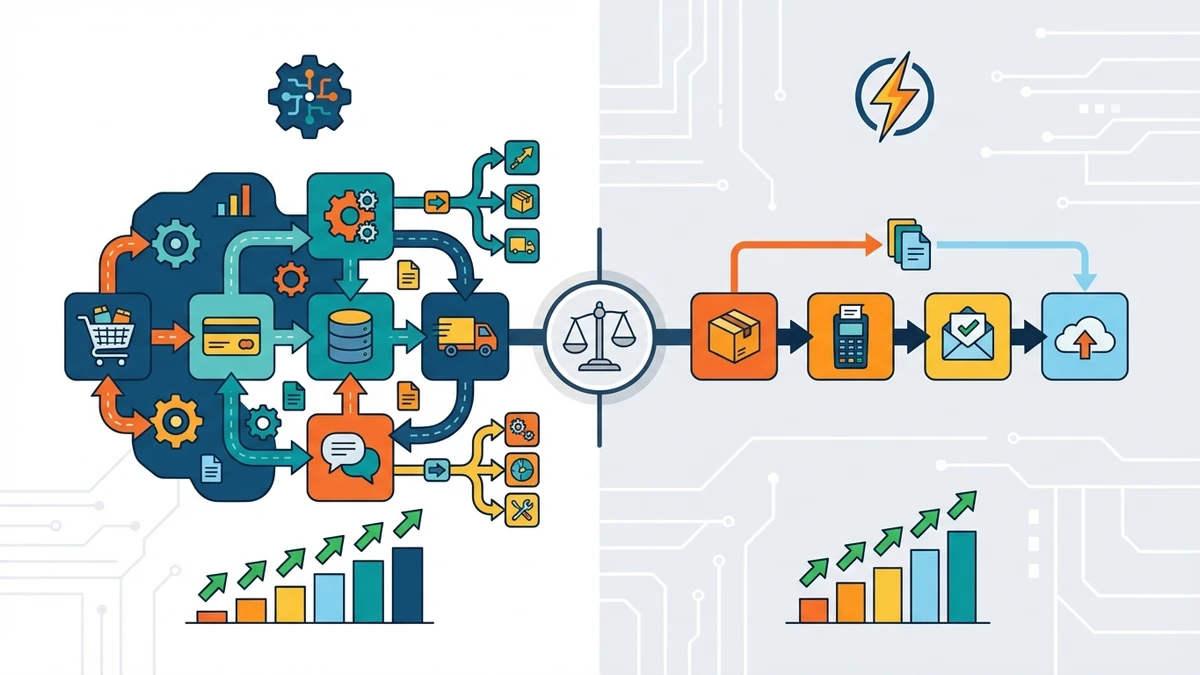
n8n handles real-time stock updates across Shopify, WooCommerce, and Amazon simultaneously using custom HTTP nodes and conditional branching. You can build logic that checks stock thresholds, routes updates to different channels based on SKU rules, and triggers reorder alerts, all within one workflow.
Zapier manages two-channel sync reliably through native integrations, but maintaining data consistency across three or more channels typically requires multiple Zaps, premium add-ons, and careful sequencing that is difficult to troubleshoot when something breaks.
Payment gateway webhook failures
This is where the operational difference between the two platforms becomes financially material. When a Stripe or PayPal webhook fails mid-order, n8n's error-handling nodes can catch the failure, log it, retry the webhook automatically, and route a notification to Slack or email.
Zapier sends a failure notification but requires manual re-runs or third-party error handling tools on most plans. For a brand doing $2M/year, a missed payment webhook during a high-traffic period is not a minor inconvenience — it is a revenue event.
Post-purchase customer journey
Building a full post-purchase sequence — order confirmation, upsell email, loyalty program enrollment, and a 7-day review request — in Zapier requires separate Zaps for each branch, and accessing multi-step conditional logic typically requires the Professional plan or higher.
n8n handles the entire sequence in a single workflow with conditional nodes, making it easier to maintain and modify as your CRM data evolves.
Think of it as the difference between managing five separate spreadsheets versus one well-structured database: the outcome looks similar on the surface, but the maintenance cost compounds over time.
Abandoned cart recovery and dynamic pricing
Zapier's pre-built templates make abandoned cart recovery fast to deploy, often live in under an hour using Klaviyo or Drip integrations. That speed advantage is real for non-technical teams.
n8n, by contrast, enables real-time competitor price monitoring via API scraping nodes and can trigger dynamic price adjustments automatically based on stock levels or demand signals. This is a capability Zapier cannot replicate natively, and it becomes a meaningful competitive edge for brands in commodity categories.
How to Choose the Right Tool Based on Your Store’s Stage
The right automation platform is not universal. It depends on your order volume, team composition, and where you are in your growth curve.
Early-stage DTC brands (under 1,000 orders/month)
Zapier's free tier and template library get automations live in hours without developer involvement. At low volume, the per-task cost is manageable, and the speed of deployment outweighs the pricing efficiency of self-hosting. This is the right trade-off when your priority is moving fast, not optimizing infrastructure.
Scaling brands ($500K to $2M revenue, 5,000 to 30,000 orders/month)
n8n's flat pricing and self-hosting become financially superior at this stage. The key question is whether your team has one developer who can manage workflow maintenance. If yes, the migration pays for itself within the first two to three months. If not, the developer cost needs to factor into your total cost of ownership calculation before committing.
Enterprise DTC and multi-brand operators
n8n's ability to connect to virtually any service with a public API, combined with self-hosted data control, makes it the stronger choice for GDPR and CCPA compliance automation, custom CDP integrations with tools like Segment or Klaviyo, and high-volume webhook processing. Data residency requirements in markets like the EU or Australia make the self-hosting option particularly valuable here.
Pro Tip: If you are evaluating n8n for the first time, start with a single high-cost Zapier workflow rather than a full migration. Rebuild that one workflow in n8n, validate the error handling, and compare monthly task consumption before moving everything over. If your store runs on Shopify or WooCommerce and the underlying technical infrastructure is not yet solid, automation tools will not fix the root problem. Getting the foundation right first — clean data architecture, reliable webhooks, and a well-structured store — is what makes any automation platform perform reliably. Hammad Shahzad delivers Shopify and WordPress development with fast delivery in 1 to 4 weeks, fixed pricing, and top-notch quality, so you can move into automation setup without delays caused by technical debt. Book a free assessment to map out what your store needs before committing to an automation stack.
Key Takeaways by Decision Type
The n8n vs Zapier for ecommerce decision simplifies to a few clear criteria:
- Choose Zapier if your team is non-technical, you process under 5,000 orders/month, and you need automations running within hours using pre-built templates
- Choose n8n if you process 10,000+ orders/month, need multi-channel inventory sync, want self-hosted data control, or are spending more than $200/month on Zapier tasks
- Cost threshold: For a $2M/year DTC brand processing 20,000 orders/month, n8n's self-hosted plan runs 60 to 80% cheaper than an equivalent Zapier Professional plan on an annualized basis
- Reliability: Both platforms exceed 99% uptime, but their webhook failure handling differs significantly. n8n's built-in retry logic and error routing nodes are meaningfully better for payment gateway integrations where dropped events have direct revenue consequences
- Transition point: The inflection point where n8n's economics clearly win is approximately 10,000 orders/month with workflows of three or more steps
Frequently Asked Questions
Can n8n automate inventory updates across 10 or more sales channels without losing data consistency?
Yes, using n8n's HTTP node and error-handling branches, but it requires developer setup and careful workflow design. Zapier can handle two to three channels reliably via native integrations without any code, making it the faster option for smaller multi-channel operations.
Which platform handles webhook failures better when a payment gateway goes down?
n8n offers built-in retry logic and custom error routing nodes that can catch failures, log them, and automatically retry without manual intervention. Zapier sends failure notifications on most plans but requires manual re-runs or third-party error handling tools to achieve the same level of automated recovery.
What is the actual annual cost difference for a $2M/year DTC brand using n8n vs Zapier?
At 20,000 orders/month with 5-step workflows generating 100,000 tasks, Zapier costs roughly $500 to $800 per month. A self-hosted n8n instance runs $20 to $60 per month in server costs with no task limits, producing an annual saving of $5,000 to $9,000 depending on your Zapier plan tier.
Can I build a complete post-purchase customer journey without custom code in either platform?
Zapier supports this with multi-step Zaps and native Klaviyo, Attentive, and SMS integrations — no code required. n8n can build more complex conditional journeys but requires basic JSON knowledge and comfort with node configuration, making it less accessible for non-technical operators.
Does n8n integrate with Shopify and WooCommerce natively?
Yes, n8n has native nodes for both Shopify and WooCommerce, covering orders, customers, products, and webhooks. Zapier also supports both platforms with a significantly larger library of pre-built templates, which reduces initial setup time for common ecommerce triggers like new order, refund created, and customer signup.
2026 update: where Make (ex-Integromat) fits
The question I now get weekly: “what about Make?” Fair — it sits squarely between the two. Make’s visual builder is friendlier than n8n’s, its per-operation pricing is far gentler than Zapier’s, and for mid-complexity ecommerce flows it’s a legitimate middle path. Where it still loses to self-hosted n8n: you can’t self-host (so costs scale with volume forever), complex branching gets visually unmanageable, and there’s no equivalent of n8n’s code nodes when an integration needs real logic. My current rule of thumb: Zapier to prototype, Make for lightweight visual flows under ~50k ops/month, n8n for anything always-on, high-volume, or AI-heavy.
If you’re mapping this to a real store, I’ve written up the five highest-ROI workflows I deploy: Shopify + n8n: 5 automations every DTC brand should run. And if your tracking is the bottleneck rather than your ops, start with the Meta CAPI setup guide instead.
Want this done for your store?
Tell me what you're working on. You get a written scope and one fixed price within 48 hours.